Auckland’s climate is an easy one to live in, and dust mites find it just as agreeable. Mild, wet winters, humid summers and a housing stock that was never built for ventilation add up to indoor conditions that favour both. Dust mites thrive in humid indoor conditions, and dampness encourages mould growth as well, which is the thread running through everything below. The house dust mite is among the most common indoor allergens.
Carpet is the largest soft surface in most homes, which puts it in the middle of that conversation. This article covers what actually accumulates in carpet, what professional carpet cleaning in Auckland removes and what it cannot touch, and the one factor that matters more than cleaning frequency: how much moisture is in your air.
None of this is medical advice. If someone in your home has asthma or allergies, their GP or specialist is the right person to guide treatment. What follows is the practical side: what is in the floor, and what can be done about it.
Why Auckland Conditions Suit Dust Mites So Well
Dust mites are microscopic arachnids. They do not bite and they are not parasites. They eat the skin cells that people and pets shed constantly, which means a dust mite’s food supply in an occupied home is effectively unlimited.
What limits them is water. Dust mites have no way to drink, so they absorb moisture straight from the air. They need humid conditions to thrive, and guidance aimed at reducing them generally targets indoor relative humidity below about 50%. A damp, poorly ventilated room sits well above that, which is the problem in a great deal of New Zealand housing.
It is worth being precise about what triggers symptoms. The mites themselves are not the allergen. Their droppings and fragments are, and those particles stay allergenic long after the mite that produced them has died. Reducing a population helps, but the accumulated allergen still needs physically removing, which is where cleaning comes in.
What Is Actually in a Carpet
Lift a well-used carpet in an Auckland home and the contents are fairly predictable: skin cells, hair, pet dander, fine mineral grit tracked in from outside, pollen, cooking oils that have settled from the air, and in a damp house, mould spores. Most of it sits well below the level a domestic vacuum reaches.
Three things about that are worth knowing.
The grit is what wears your carpet out, because underfoot it acts like sandpaper on the fibre. The oily residue is what makes traffic lanes look grey, because fine soil sticks to it. And the biological material, the skin cells and dander, is the part that feeds a dust mite population.
So the case for regular cleaning is not only about appearance. Removing the food supply and the accumulated allergen does more for the floor than any single other thing you can do.
Is Carpet Bad for Allergies? An Honest Answer
This question deserves an honest answer rather than a sales pitch, and the honest answer is that the research goes both ways.
Carpet does collect dust mite allergen. Studies have found carpet holds more dust and allergen than hard floors. What nobody has settled is how much of it you actually end up breathing. Carpet traps particles down in the pile. On a hard floor they sit on the surface and lift into the air every time someone walks past. Studies have come out both ways on that, depending on how much the floor gets disturbed and how well it gets cleaned.
Cleaning takes out some of what has built up. How much depends on the carpet, how dirty it is and the method used.
What it really comes down to is upkeep rather than flooring. Carpet that gets vacuumed properly and cleaned now and then stays on top of it. Carpet left for years does not, and stirring it up releases everything sitting in there.
So carpet is not the wrong choice for a household with allergies. It just needs looking after in a way hard flooring does not. If someone in your home has been diagnosed with a dust mite allergy, talk to their doctor about flooring and bedding, because cutting back soft surfaces in the bedroom does help some people.
Humidity Is the Lever
Keeping indoor relative humidity below 60% is the general target for limiting mould growth on indoor surfaces, and guidance aimed specifically at dust mites goes lower again, usually below about 50%. Neither figure guarantees dry surfaces in every room, but moving in that direction works against mould and mites at the same time.
The practical steps are unglamorous and they work.
Heat the house. BRANZ research has found that homes heated to 18°C or above experience far fewer periods of high humidity, because warmer air holds moisture rather than dumping it onto cold surfaces as condensation.
Ventilate deliberately. BRANZ has also found that opening windows wide for just 10 to 15 minutes a day measurably lowers moisture levels. A short, full air change does more than a window cracked open all day.
Extract at the source. Showers, cooking and unvented clothes dryers put litres of water into the air. Use the extractor fan, run it for a while afterwards, and dry washing outside whenever Auckland allows.
Check the obvious culprits. Subfloor moisture, a slow leak under a sink, blocked guttering and damp carpet edges against an exterior wall all keep a house wet no matter how well you clean.
Carpet cleaning removes what has accumulated. Humidity control stops it accumulating as fast. You need both, and the second one is the part most people skip.
What Professional Carpet Cleaning Removes, and What It Doesn’t
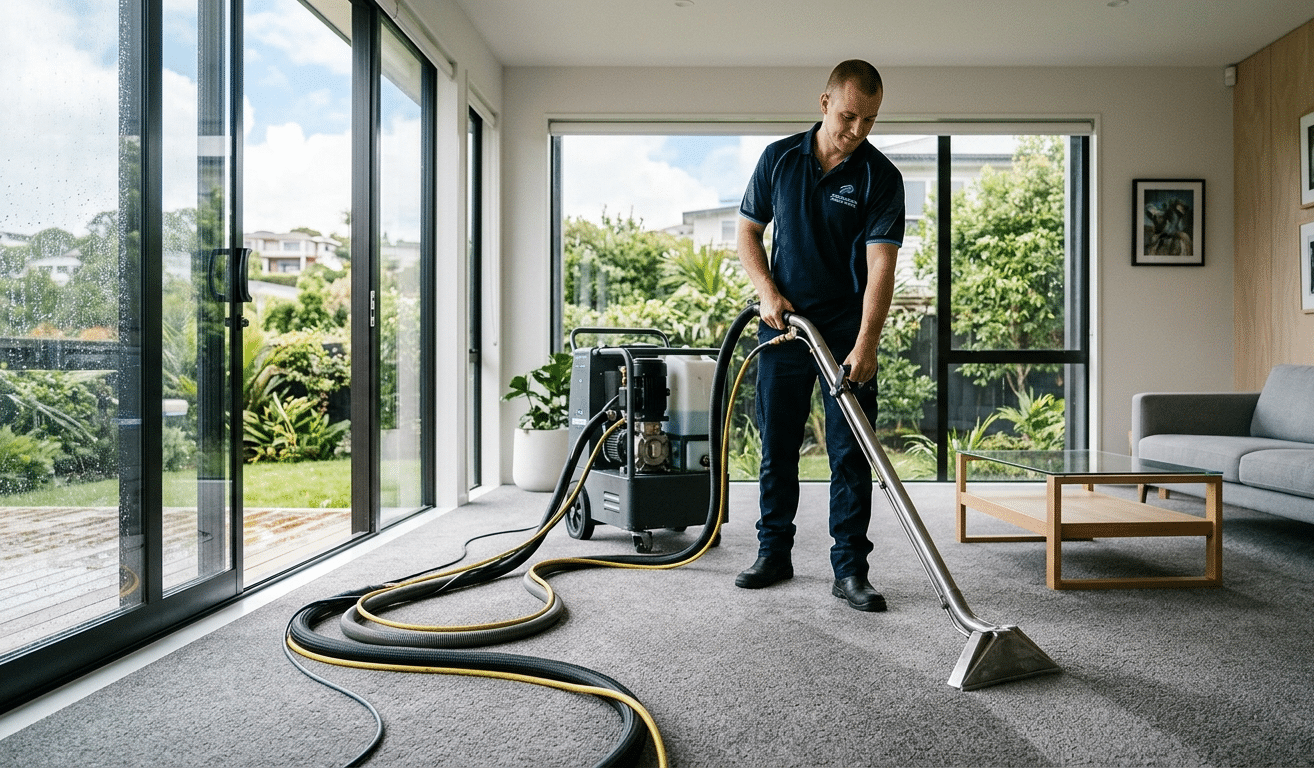
Hot water extraction, which most people call steam cleaning, is the method professional carpet cleaners use for this. It injects hot water and cleaning solution into the pile under pressure and immediately draws it back out under suction, carrying the loosened soil with it. Done properly it removes deep dry soil, the oily residues that hold grey traffic lanes in place, and some of the accumulated allergen that vacuuming cannot reach. Carpet sanitisation is available as an additional treatment after cleaning.
However, it will not permanently eliminate dust mites from your home, because the ones in your mattress, bedding, curtains and upholstery are unaffected, and because a humid house simply repopulates. It will not fix a damp problem, and if the underlying moisture source is still there, the conditions that caused the issue return within weeks. It will not restore fibre that has physically worn out. And it will not remove odour that is coming from contaminated underlay or subfloor rather than from the carpet itself.
Treat cleaning as resetting the accumulated load, not as a cure. Paired with heating and ventilation, it is genuinely effective. On its own in a cold, damp house, it is temporary.
Why DIY Carpet Cleaning Machines Can Make Damp Worse
The risk with any machine, hired or domestic, is over-wetting: putting more water into the carpet than comes back out. Instead of cleaning the carpet, you have wet it.
Carpet that stays damp is a problem in a humid climate. The backing and underlay stay wet long after the surface feels dry, and that is when musty odour develops and mould becomes possible in the very layer nobody can inspect. Over-wetting also encourages the carpet to relax and ripple, and it can start browning on natural fibres.
That is why controlled drying matters, with air movement used to pull the moisture out rather than leaving it to evaporate on its own schedule. If your carpet is still damp the day after a clean, contact whoever cleaned it and ask for advice, since how long a carpet takes to dry depends on the carpet, the room and the conditions on the day.
Winter Condensation, Mould and Carpet Edges
The place to check first is where carpet meets an exterior wall, particularly in a bedroom on the south side of the house.
Cold winter nights cool those walls, moist indoor air condenses against them, and water runs down to the skirting and into the carpet edge and underlay. Because it happens at the perimeter, often behind furniture, it is routinely missed until there is a smell, a dark edge along the skirting, or visible mould on the wall above.
If you find it, carpet cleaning is the last step rather than the first. Deal with the ventilation and heating, dry the area properly, and then have the carpet assessed. Our carpet cleaners check the underlay and the perimeter, not just the surface. Where the backing or underlay has broken down, the affected section is cut out and patched, which is a standard part of carpet repairs in Auckland and much cheaper than replacing a room. Where it has been caught early, drying and cleaning is often all that is needed.
A Realistic Routine
Vacuum high-traffic areas and bedrooms twice a week if you can, slowly, with several passes. Speed is what makes vacuuming ineffective, not the machine.
Use mats at every external door and take shoes off inside. This is the single biggest reduction in the grit and outdoor allergen entering your carpet.
Wash bedding weekly, following the care label. Washing it weekly is the part that matters, and high temperatures are not essential to the benefit. Bedding, not carpet, is where most mite exposure happens.
As our own general guide, book professional carpet cleaning every 12 months in a typical family home, every 6 to 12 months with pets, allergy sufferers or a home that struggles with damp, and every 12 to 18 months in a quiet household with little traffic. Where damp is persistent, the moisture source needs investigating rather than managing with more frequent cleans.
Work on bringing humidity down year round using the steps above.
Rugs, Mattresses and the Rest of the Soft Furnishings
A clean carpet in a room full of untouched soft furnishings is only part of the picture. Rugs in particular collect everything the carpet does and then some, because they sit in traffic paths and are rarely vacuumed on both sides.
Rugs cannot be cleaned the way fitted carpet is, since fibre, dyes and backings all behave differently once wet, so professional rug cleaning in Auckland is done at a facility after the rug has been assessed. Most household rugs benefit from attention every 12 to 18 months. Upholstery is worth including on the same cycle, as sofas hold skin cells and dander in much the same way carpet does.
Carpet Cleaning FAQs
How long does carpet take to dry after professional carpet cleaning?
With professional extraction and air movement, usually a few hours, and longer in a cold or humid house. Open windows and run a heater to speed it up. Drying time depends on the carpet, the room and the conditions on the day, so if it is still damp the next day, contact the cleaner for advice.
Will carpet cleaning get rid of dust mites?
It can remove some of the accumulated allergen and some of the skin cells mites feed on. It will not eliminate mites from the house, because bedding, mattresses, curtains and upholstery are separate reservoirs, and because mite numbers recover in a home that stays humid. Lowering humidity is what reduces the population.
How often should carpet cleaning be done in an Auckland home?
Every 12 months suits most family homes. Make it 6 to 12 months with pets, young children, allergy sufferers, or a home that struggles with damp. A low-traffic household can stretch to 18 months.
Does professional carpet cleaning cause mould?
Correctly done, no, because the water goes back out as fast as it goes in and the drying is controlled. Mould risk comes from over-wetting, and from an existing damp problem that cleaning did not cause and cannot fix.
Can you clean carpet after a leak or flood?
It depends on the source of the water and the condition of the carpet and underlay. Where the water was clean, acting fast matters most, and prompt professional drying is often what decides whether carpet and underlay can be saved. Contaminated floodwater is different: official New Zealand advice is to assume floodwater carries sewage, farm run-off and chemicals, and to discard contaminated materials, carpet included, where they cannot be properly cleaned and disinfected. Either way, that call gets made on site rather than in a blog post. Where material has already broken down, patching or a section replacement may be needed, and any carpet repair in Auckland is straightforward to arrange alongside the drying work.
Are the products safe for children and pets?
Our cleaning uses biodegradable products with low-allergen options available, and we will discuss sensitivities before we start. Tell us in advance if anyone in the house has asthma, a fragrance sensitivity or a chemical allergy, and our carpet cleaners will adjust the products accordingly.
Should rugs be cleaned at the same time as the carpet?
It makes sense to coordinate them, but they are different jobs. Rugs come to our Mt Eden facility rather than being cleaned in place, and our rug cleaners in Auckland assess each rug for fibre, construction and dye stability first, because an approach that is right for fitted carpet can damage a wool or viscose rug.
Get a Straight Assessment of Your Floor
In 2024/25 about one in ten New Zealand children aged 2 to 14 had asthma and was using treatment for it, roughly 94,000 children, according to the New Zealand Health Survey. Indoor air quality is not a niche concern in this country. Carpet is one part of it, and a manageable part.
If you are dealing with a musty smell, visible mould, a damp edge along a skirting board, or you simply want the accumulated load out of your floor, we will tell you what we find and what will actually help, including when the answer is ventilation rather than cleaning. Our carpet cleaners in Auckland have worked on homes across the city since the 1990s, our technicians are IICRC-certified, and every quote is free and no-obligation.
Call 0508 787 4366 to book an assessment.
Sources referenced: New Zealand Health Survey 2024/25, Ministry of Health; BRANZ research on indoor air quality and ventilation in New Zealand houses; Tenancy Services healthy homes standards.